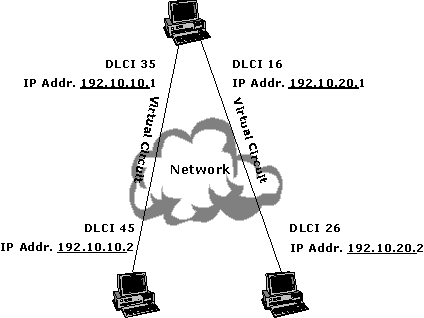
This topic describes the configuration relationship between virtual circuits (VC) and Internet Protocol (IP) addresses.
A VC is a logical connection configured between two host systems attached to a packet-switching network. From the host systems' point of view, a VC acts like a point-to-point connection regardless of the actual path the data packets may take through the network. Packet routing through the network depends on IP addresses configured to identify the VC and the hosts it connects.
Host systems using frame relay or X.25 protocols attach to a packet-switching network through logical channels. A pair of logical channels (one local and one remote) form a VC across the intervening network. In your adapter configuration, each frame relay logical channel is identified by a data link connection identifier (DLCI). Each X.25 logical channel is identified by a channel number. Depending on the protocol, you can configure VCs as permanent (PVC) or switched (SVC).
For IP addressing purposes, a VC is an IP subnetwork. Therefore, when you configure a VC, the IP addresses for the paired logical channels must have a common network ID. (The host portion of the IP address should be different for each logical channel.) In addition, this network ID should be unique. That is, no other VC (or any other subnetwork) should use the same network ID.
In the frame relay example below, each VC is defined as an IP subnetwork with a unique network ID (192.10.10. for one VC and 192.10.20. for the other).