


| Rabbit 2000™ Microprocessor User's Manual |
| |
|
|
18. Rabbit Instructions
Summary
Load Immediate Data
8-bit Indexed Load and Store
16-bit Indexed Loads and Stores
16-bit Load and Store 20-bit Address
Register to Register Moves
Exchange Instructions
Stack Manipulation Instructions
16-bit Arithmetic and Logical Ops
8-bit Arithmetic and Logical Ops
8-bit Bit Set, Reset and Test
8-bit Increment and Decrement
8-bit Fast A register Operations
8-bit Shifts and Rotates
Instruction Prefixes
Block Move Instructions
Control Instructions - Jumps and Calls
Miscellaneous Instructions
Privileged Instructions
Instructions in Alphabetical Order With Binary EncodingSpreadsheet Conventions
ALTD ("A" Column) Symbol Key ALTD selects alternate flags
ALTD selects alternate flags and register
ALTD selects alternate register
ALTD operation is a special case
IOI and IOE ("I" Column) Symbol Key IOI and IOE affect source and destination
IOI and IOE affect destination
IOI and IOE affect source
1 The L/V (logical/overflow) flag serves a dual purpose--L/V is set to 1 for logical operations if any of the four most significant bits of the result are 1, and L/V is reset to 0 if all four of the most significant bits of the result are 0.
Symbols
Bit select:
000 = bit 0, 001 = bit 1,
010 = bit 2, 011 = bit 3,
100 = bit 4, 101 = bit 5,
110 = bit 6, 111 = bit 7
Condition code select:
00 = NZ, 01 = Z,
10 = NC, 11 = C
7-bit (signed) displacement. Expressed in two's complement.
Word register select destination: 00 = BC, 01 = DE, 10 = HL, 11 = SP
Word register select alternate: 00 = BC', 01 = DE', 10 = HL'
8-bit (signed) displacement added to PC.
Condition code select:
000 = NZ (non zero), 001 = Z (zero),
010 = NC (non carry), 011 = C (carry),
100 = LZ1 (logical zero), 101 = LO2 (logical one),
110 = P (sign plus), 111 = M (sign minus)
MSB of a 16-bit constant.
16-bit constant.
8-bit constant or LSB of a 16-bit constant.
Byte register select:
000 = B, 001 = C,
010 = D, 011 = E,
100 = H, 101 = L,
111 = A
Word register select (source): 00 = BC, 01 = DE, 10 = HL, 11 = SP
Restart address select:
010 = 0020h, 011 = 0030h,
100 = 0040h, 101 = 0050h,
111 = 0070h
Word register select: 00 = BC, 01 = DE, 10 = IX, 11 = SP
Word register select: 00 = BC, 01 = DE, 10 = IY, 11 = SP
Word register select: 00 = BC, 01 = DE, 10 = HL, 11 = AF
1 Logical zero if all four of the most significant bits of the result are 0.
2 Logical one if any of the four most significant bits of the result are 1.
18.1 Load Immediate Data
Instruction   clk   A  I S Z V C  Operation
LD IX,mn      8          - - - -  IX = mn
LD IY,mn      8          - - - -  IY = mn
LD dd,mn      6     r    - - - -  dd = mn
LD r,n        4     r    - - - -  r = n
18.2 Load & Store to Immediate Address
Instruction   clk   A  I S Z V C  Operation
LD (mn),A     10       d - - - -  (mn) = A
LD A,(mn)     9     r  s - - - -  A = (mn)
LD (mn),HL    13       d - - - -  (mn) = L; (mn+1) = H
LD (mn),IX    15       d - - - -  (mn) = IXL; (mn+1) = IXH
LD (mn),IY    15       d - - - -  (mn) = IYL; (mn+1) = IYH
LD (mn),ss    15       d - - - -  (mn) = ssl; (mn+1) = ssh
LD HL,(mn)    11    r  s - - - -  L = (mn); H = (mn+1)
LD IX,(mn)    13       s - - - -  IXL = (mn); IXH = (mn+1)
LD IY,(mn)    13       s - - - -  IYL = (mn); IYH = (mn+1)
LD dd,(mn)    13    r  s - - - -  ddl = (mn); ddh = (mn+1)
18.3 8-bit Indexed Load and Store
Instruction   clk   A  I S Z V C  Operation
LD A,(BC)     6     r  s - - - -  A = (BC)
LD A,(DE)     6     r  s - - - -  A = (DE)
LD (BC),A     7        d - - - -  (BC) = A
LD (DE),A     7        d - - - -  (DE) = A
LD (HL),n     7        d - - - -  (HL) = n
LD (HL),r     6        d - - - -  (HL) = r = B, C, D, E, H, L, A
LD r,(HL)     5     r  s - - - -  r = (HL)
LD (IX+d),n   11       d - - - -  (IX+d) = n
LD (IX+d),r   10       d - - - -  (IX+d) = r
LD r,(IX+d)   9     r  s - - - -  r = (IX+d)
LD (IY+d),n   11       d - - - -  (IY+d) = n
LD (IY+d),r   10       d - - - -  (Iy+d) = r
LD r,(IY+d)   9     r  s - - - -  r = (IY+d)
18.4 16-bit Indexed Loads and Stores
Instruction   clk   A  I S Z V C  Operation
LD (HL+d),HL  13       d - - - -  (HL+d) = L; (HL+d+1) = H
LD HL,(HL+d)  11    r  s - - - -  L = (HL+d); H = (HL+d+1)
LD (SP+n),HL  11         - - - -  (SP+n) = L; (SP+n+1) = H
LD (SP+n),IX  13         - - - -  (SP+n) = IXL; (SP+n+1) = IXH
LD (SP+n),IY  13         - - - -  (SP+n) = IYL; (SP+n+1) = IYH
LD HL,(SP+n)  9     r    - - - -  L = (SP+n); H = (SP+n+1)
LD IX,(SP+n)  11         - - - -  IXL = (SP+n); IXH = (SP+n+1)
LD IY,(SP+n)  11         - - - -  IYL = (SP+n); IYH = (SP+n+1)
LD (IX+d),HL  11       d - - - -  (IX+d) = L; (IX+d+1) = H
LD HL,(IX+d)  9     r  s - - - -  L = (IX+d); H = (IX+d+1)
LD (IY+d),HL  13       d - - - -  (IY+d) = L; (IY+d+1) = H
LD HL,(IY+d)  11   r  s - - - -  L = (IY+d); H = (IY+d+1)
18.5 16-bit Load and Store 20-bit Address
Instruction   clk   A  I S Z V C  Operation
LDP (HL),HL   12         - - - -  (HL) = L; (HL+1) = H.
                                  (Adr[19:16] = A[3:0])
LDP (IX),HL   12         - - - -  (IX) = L; (IX+1) = H.
                                  (Adr[19:16] = A[3:0])
LDP (IY),HL   12         - - - -  (IY) = L; (IY+1) = H.
                                  (Adr[19:16] = A[3:0])
LDP HL,(HL)   10         - - - -  L = (HL); H = (HL+1).
                                  (Adr[19:16] = A[3:0])
LDP HL,(IX)   10         - - - -  L = (IX); H = (IX+1).
                                  (Adr[19:16] = A[3:0])
LDP HL,(IY)   10         - - - -  L = (IY); H = (IY+1).
                                  (Adr[19:16] = A[3:0])
LDP (mn),HL   15         - - - -  (mn) = L; (mn+1) = H.
                                  (Adr[19:16] = A[3:0])
LDP (mn),IX   15         - - - -  (mn) = IXL; (mn+1) = IXH.
                                  (Adr[19:16] = A[3:0])
LDP (mn),IY   15         - - - -  (mn) = IYL; (mn+1) = IYH.
                                  (Adr[19:16] = A[3:0])
LDP HL,(mn)   13         - - - -  L = (mn); H = (mn+1).
                                  (Adr[19:16] = A[3:0])
LDP IX,(mn)   13         - - - -  IXL = (mn); IXH = (mn+1).
                                  (Adr[19:16] = A[3:0])
LDP IY,(mn)   13         - - - -  IYL = (mn); IYH = (mn+1).
                                  (Adr[19:16] = A[3:0])
Note that the LDP instructions wrap around on a 64K page boundary. Since the LDP instruction operates on two-byte values, the second byte will wrap around and be written at the start of the page if you try to read or write across a page boundary. Thus, if you fetch or store at address 0xn,0xFFFF, you will get the bytes located at 0xn,0xFFFF and 0xn,0x0000 instead of 0xn,0xFFFFand 0x(n+1),0x0000 as you might expect. Therefore, do not use LDP at any physical address ending in 0xFFFF.
18.6 Register to Register Moves
Instruction   clk   A  I S Z V C  Operation
LD r,g        2     r    - - - -  r = g; r,g any of B,
                                  C, D, E, H, L, A
LD A,EIR      4     fr   * * - -  A = EIR
LD A,IIR      4     fr   * * - -  A = IIR
LD A,XPC      4     r    - - - -  A = MMU
LD EIR,A      4          - - - -  EIR = A
LD IIR,A      4          - - - -  IIR = A
LD XPC,A      4          - - - -  XPC = A
LD HL,IX      4     r    - - - -  HL = IX
LD HL,IY      4     r    - - - -  HL = IY
LD IX,HL      4          - - - -  IX = HL
LD IY,HL      4          - - - -  IY = HL
LD SP,HL      2          - - - -  SP = HL
LD SP,IX      4          - - - -  SP = IX
LD SP,IY      4          - - - -  SP = IY
LD dd',BC     4          - - - -  dd' = BC (dd': 00-BC',
                                  01-DE', 10-HL')
LD dd',DE     4          - - - -  dd' = DE (dd': 00-BC',
                                  01-DE', 10-HL')
18.7 Exchange Instructions
Instruction   clk   A  I S Z V C  Operation
EX (SP),HL    15    r    - - - -  H <-> (SP+1); L <-> (SP)
EX (SP),IX    15         - - - -  IXH <-> (SP+1); IXL <-> (SP)
EX (SP),IY    15        - - - -  IYH <-> (SP+1); IYL <-> (SP)
EX AF,AF'     2          - - - -  AF <-> AF'
EX DE',HL     2     s    - - - -  if (!ALTD) then DE' <-> HL
                                   else DE' <-> HL'
EX DE',HL'    4     s    - - - -   DE' <-> HL'
EX DE,HL      2     s    - - - -  if (!ALTD) then DE <-> HL
                                  else DE <-> HL'
EX DE,HL'     4     s    - - - -  DE <-> HL'
EXX           2          - - - -  BC <-> BC'; DE <-> DE';
                                  HL <-> HL'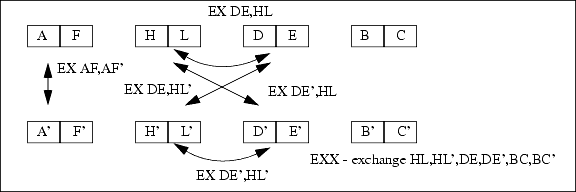
18.8 Stack Manipulation Instructions
Instruction   clk   A  I S Z V C  Operation
ADD SP,d      4     f    - - - *  SP = SP + d -- d=0 to 255
POP IP        7          - - - -  IP = (SP); SP = SP+1
POP IX        9          - - - -  IXL = (SP); IXH = (SP+1);
                                  SP = SP+2
POP IY        9          - - - -  IYL = (SP); IYH = (SP+1);
                                  SP = SP+2
POP zz        7     r    - - - -  zzl = (SP); zzh = (SP+1);
                                  SP=SP+2 -- zz= BC,DE,HL,AF
PUSH IP       9          - - - -  (SP-1) = IP; SP = SP-1
PUSH IX       12         - - - -  (SP-1) = IXH; (SP-2) = IXL;
                                   SP = SP-2
PUSH IY       12         - - - -  (SP-1) = IYH; (SP-2) = IYL;
                                  SP = SP-2
PUSH zz       10         - - - -  (SP-1) = zzh; (SP-2) = zzl;
                                   SP=SP-2 --zz= BC,DE,HL,AF
18.9 16-bit Arithmetic and Logical Ops
Instruction   clk   A  I S Z V C  Operation
ADC HL,ss     4     fr   * * V *  HL = HL + ss + CF  -- ss=BC,
                                  DE, HL, SP
ADD HL,ss     2     fr   - - - *  HL = HL + ss
ADD IX,xx     4     f    - - - *  IX = IX + xx  -- xx=BC,
                                  DE, IX, SP
ADD IY,yy     4     f    - - - *  IY = IY + yy  -- yy=BC,
                                  DE, IY, SP
ADD SP,d      4     f    - - - *  SP = SP + d -- d=0 to 255
AND HL,DE     2     fr   * * L 0  HL = HL & DE
AND IX,DE     4     f    * * L 0  IX = IX & DE
AND IY,DE     4     f    * * L 0  IY = IY & DE
BOOL HL       2     fr   * * 0 0  if (HL != 0) HL = 1,
                                   set flags to match HL
BOOL IX       4     f    * * 0 0  if (IX != 0) IX = 1
BOOL IY       4     f    * * 0 0  if (IY != 0) IY = 1
DEC IX        4          - - - -  IX = IX - 1
DEC IY        4          - - - -  IY = IY - 1
DEC ss        2     r    - - - -  ss = ss - 1 -- ss= BC,
                                  DE, HL, SP
INC IX        4          - - - -  IX = IX + 1
INC IY        4          - - - -  IY = IY + 1
INC ss        2     r    - - - -  ss = ss + 1 -- ss= BC,
                                  DE, HL, SP
MUL           12         - - - -  HL:BC = BC * DE, signed
                                  32 bit result. DE unchanged
OR HL,DE      2     fr   * * L 0  HL = HL | DE -- bitwise or
OR IX,DE      4     f    * * L 0  IX = IX | DE
OR IY,DE      4     f    * * L 0  IY = IY | DE
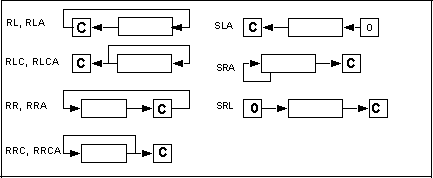
RL DE         2     fr   * * L *  {CY,DE} = {DE,CY} --
                                  left shift with CF
RR DE         2     fr   * * L *  {DE,CY} = {CY,DE}
RR HL         2     fr   * * L *  {HL,CY} = {CY,HL}
RR IX         4     f    * * L *  {IX,CY} = {CY,IX}
RR IY         4     f    * * L *  {IY,CY} = {CY,IY}
SBC HL,ss     4     fr   * * V *  HL=HL-ss-CY
                                  (cout if (ss-CY)>hl)
18.10 8-bit Arithmetic and Logical Ops
Instruction   clk   A  I S Z V C  Operation
ADC A,(HL)    5     fr s * * V *  A = A + (HL) + CF
ADC A,(IX+d)  9     fr s * * V *  A = A + (IX+d) + CF
ADC A,(IY+d)  9     fr s * * V *  A = A + (IY+d) + CF
ADC A,n       4     fr   * * V *  A = A + n + CF
ADC A,r       2     fr   * * V *  A = A + r + CF
ADD A,(HL)    5     fr s * * V *  A = A + (HL)
ADD A,(IX+d)  9     fr s * * V *  A = A + (IX+d)
ADD A,(IY+d)  9     fr s * * V *  A = A + (IY+d)
ADD A,n       4     fr   * * V *  A = A + n
ADD A,r       2     fr   * * V *  A = A + r
AND (HL)      5     fr s * * L 0  A = A & (HL)
AND (IX+d)    9     fr s * * L 0  A = A & (IX+d)
AND (IY+d)    9     fr s * * L 0  A = A & (IY+d)
AND n         4     fr   * * L 0  A = A & n
AND r         2     fr   * * L 0  A = A & r
CP* (HL)      5     f  s * * V *  A - (HL)
CP* (IX+d)    9     f  s * * V *  A - (IX+d)
CP* (IY+d)    9     f  s * * V *  A - (IY+d)
CP* n         4     f    * * V *  A - n
CP* r         2     f    * * V *  A - r
OR (HL)       5     fr s * * L 0  A = A | (HL)
OR (IX+d)     9     fr s * * L 0  A = A | (IX+d)
OR (IY+d)     9     fr s * * L 0  A = A | (IY+d)
OR n          4     fr   * * L 0  A = A | n
OR r          2     fr   * * L 0  A = A | r
SBC* (IX+d)   9     fr s * * V *  A = A - (IX+d) - CY
SBC* (IY+d)   9     fr s * * V *  A = A - (IY+d) - CY
SBC* A,(HL)   5     fr s * * V *  A = A - (HL) - CY
SBC* A,n      4     fr   * * V *  A = A-n-CY (cout if (r-CY)>A)
SBC* A,r      2     fr   * * V *  A = A-r-CY (cout if (r-CY)>A)
SUB (HL)      5     fr s * * V *  A = A - (HL)
SUB (IX+d)    9     fr s * * V *  A = A - (IX+d)
SUB (IY+d)    9     fr s * * V *  A = A - (IY+d)
SUB n         4     fr   * * V *  A = A - n
SUB r         2     fr   * * V *  A = A - r
XOR (HL)      5     fr s * * L 0  A = [A & ~(HL)] | [~A & (HL)]
XOR (IX+d)    9      fr s * * L 0  A = [A & ~(IX+d)] | [~A & (IX+d)]
XOR (IY+d)    9      fr s * * L 0  A = [A & ~(IY+d)] | [~A & (IY+d)]
XOR n         4     fr   * * L 0  A = [A & ~n] | [~A & n]
XOR r         2     fr   * * L 0  A = [A & ~r] | [~A & r]
* SBC and CP instruction output inverted carry. C is set if A<B if the operation or virtual operation is (A-B). Carry is cleared if A>=B. SUB outputs carry in opposite sense from SBC and CP. 18.11 8-bit Bit Set, Reset and Test
Instruction   clk   A  I S Z V C  Operation
BIT b,(HL)    7     f  s - * - -  (HL) & bit
BIT b,(IX+d)) 10    f  s - * - -  (IX+d) & bit
BIT b,(IY+d)) 10    f  s - * - -  (IY+d) & bit
BIT b,r       4     f    - * - -  r & bit
RES b,(HL)    10       d - - - -  (HL) = (HL) & ~bit
RES b,(IX+d)  13       d - - - -  (IX+d) = (IX+d) & ~bit
RES b,(IY+d)  13       d - - - -  (IY+d) = (IY+d) & ~bit
RES b,r       4     r    - - - -  r = r & ~bit
SET b,(HL)    10       b - - - -  (HL) = (HL) | bit
SET b,(IX+d)  13       b - - - -  (IX+d) = (IX+d) | bit
SET b,(IY+d)  13       b - - - -  (IY+d) = (IY+d) | bit
SET b,r       4    r    - - - -  r = r | bit
18.12 8-bit Increment and Decrement
Instruction   clk   A  I S Z V C  Operation
DEC (HL)      8     f  b * * V -  (HL) = (HL) - 1
DEC (IX+d)    12    f  b * * V -  (IX+d) = (IX+d) -1
DEC (IY+d)    12    f  b * * V -  (IY+d) = (IY+d) -1
DEC r         2     fr   * * V -  r = r - 1
INC (HL)      8     f  b * * V -  (HL) = (HL) + 1
INC (IX+d)    12    f  b * * V -  (IX+d) = (IX+d) + 1
INC (IY+d)    12    f  b * * V -  (IY+d) = (IY+d) + 1
INC r         2     fr   * * V -  r = r + 1
18.13 8-bit Fast A register Operations
Instruction   clk   A  I S Z V C  Operation
CPL           2     r    - - - -  A = ~A
NEG           4     fr   * * V *  A = 0 - A
RLA           2     fr   - - - *  {CY,A} = {A,CY}
RLCA          2     fr   - - - *  A = {A[6,0],A[7]}; CY = A[7]
RRA           2     fr   - - - *  {A,CY} = {CY,A}
RRCA          2     fr   - - - *  A = {A[0],A[7,1]}; CY = A[0]
18.14 8-bit Shifts and Rotates
Instruction   clk   A  I S Z V C  Operation
RL (HL)       10    f  b * * L *  {CY,(HL)} = {(HL),CY}
RL (IX+d)     13    f  b * * L *  {CY,(IX+d)} = {(IX+d),CY}
RL (IY+d)     13    f  b * * L *  {CY,(IY+d)} = {(IY+d),CY}
RL r          4     fr   * * L *  {CY,r} = {r,CY}
RLC (HL)      10    f  b * * L *  (HL) = {(HL)[6,0],(HL)[7]};
                                  CY = (HL)[7]
RLC (IX+d)    13    f  b * * L *  (IX+d) = {(IX+d)[6,0],
                                   (IX+d)[7]}; CY = (IX+d)[7]
RLC (IY+d)    13    f  b * * L *  (IY+d) = {(IY+d)[6,0],
                                  (IY+d)[7]}; CY = (IY+d)[7]
RLC r         4     fr   * * L *  r = {r[6,0],r[7]}; CY = r[7]
RR (HL)       10    f  b * * L *  {(HL),CY} = {CY,(HL)}
RR (IX+d)     13    f  b * * L *  {(IX+d),CY} = {CY,(IX+d)}
RR (IY+d)     13    f  b * * L *  {(IY+d),CY} = {CY,(IY+d)}
RR r          4     fr   * * L *  {r,CY} = {CY,r}
RRC (HL)      10    f  b * * L *  (HL) = {(HL)[0],(HL)[7,1]};
                                   CY = (HL)[0]
RRC (IX+d)    13    f  b * * L *  (IX+d) = {(IX+d)[0],
                                  (IX+d)[7,1]}; CY = (IX+d)[0]
RRC (IY+d)    13    f  b * * L *  (IY+d) = {(IY+d)[0],(
                                   IY+d)[7,1]}; CY = (IY+d)[0]
RRC r         4     fr   * * L *  r = {r[0],r[7,1]}; CY = r[0]
SLA (HL)      10    f  b * * L *  (HL) = {(HL)[6,0],0}; CY =
                                  (HL)[7]
SLA (IX+d)    13    f  b * * L *  (IX+d) = {(IX+d)[6,0],0};
                                   CY = (IX+d)[7]
SLA (IY+d)    13    f  b * * L *  (IY+d) = {(IY+d)[6,0],0};
                                   CY = (IY+d)[7]
SLA r         4     fr   * * L *  r = {r[6,0],0}; CY = r[7]
SRA (HL)      10    f  b * * L *  (HL) = {(HL)[7],(HL)[7,1]};
                                  CY = (HL)[0]
SRA (IX+d)    13    f  b * * L *  (IX+d) = {(IX+d)[7],
                                  (IX+d)[7,1]}; CY = (IX+d)[0]
SRA (IY+d)    13    f  b * * L *  (IY+d) = {(IY+d)[7],
                                  (IY+d)[7,1]}; CY = (IY+d)[0]
SRA r         4     fr   * * L *  r = {r[7],r[7,1]}; CY = r[0]
SRL (HL)      10    f  b * * L *  (HL) = {0,(HL)[7,1]};
                                  CY = (HL)[0]
SRL (IX+d)    13    f  b * * L *  (IX+d) = {0,(IX+d)[7,1]};
                                   CY = (IX+d)[0]
SRL (IY+d)    13    f  b * * L *  (IY+d) = {0,(IY+d)[7,1]};
                                   CY = (IY+d)[0]
SRL r         4     fr   * * L *  r = {0,r[7,1]};
                                  CY = r[0]
18.15 Instruction Prefixes
Instruction   clk   A  I S Z V C  Operation
ALTD          2          - - - - alternate register destinatIn
                                 for next Instruction
IOE           2          - - - -  I/O external prefix
IOI          2          - - - -  I/O internal prefix
18.16 Block Move Instructions
Instruction   clk   A  I S Z V C  Operation
LDD           10       d - - * -  (DE) = (HL); BC = BC-1;
                                   DE = DE-1; HL = HL-1
LDDR          6+7i     d - - * -  if {BC != 0} repeat:
LDI           10       d - - * -  (DE) = (HL); BC = BC-1;
                                   DE = DE+1; HL = HL+1
LDIR          6+7i     d - - * -  if {BC != 0} repeat:
If any of the block move instructions are prefixed by an I/O prefix, the destination will be in the specified I/O space. Add 1 clock for each iteration for the prefix if the prefix is IOI (internal I/O). If the prefix is IOE, add 2 clocks plus the number of I/O wait states enabled. The V flag is set when BC transitions from 1 to 0. If the V flag is not set another step is performed for the repeating versions of the instructions. Interrupts can occur between different repeats, but not within an iteration equivalent to LDD or LDI. Return from the interrupt is to the first byte of the instruction which is the I/O prefix byte if there is one.
18.17 Control Instructions - Jumps and Calls
Instruction   clk   A  I S Z V C  Operation
CALL mn       12         - - - -  (SP-1) = PCH; (SP-2) = PCL;
                                   PC = mn; SP = SP-2
DJNZ j        5     r    - - - -  B = B-1; if {B != 0} PC = PC + j
JP (HL)       4          - - - -  PC = HL
JP (IX)       6          - - - -  PC = IX
JP (IY)       6          - - - -  PC = IY
JP f,mn       7          - - - -  if {f} PC = mn
JP mn         7          - - - -  PC = mn
JR cc,e       5          - - - -  if {cc} PC = PC + e
JR e          5          - - - -  PC = PC + e (if e==0 next
                                  seq inst is executed)
LCALL xpc,mn  19         - - - -  (SP-1) = XPC; (SP-2) = PCH;
                                  (SP-3) = PCL;  XPC=xpc;
                                  PC = mn; SP = (SP-3)
LJP xpc,mn    10         - - - -  XPC=xpc; PC = mn
LRET          13         - - - -  PCL = (SP); PCH = (SP+1);
                                  XPC = (SP+2);  SP = SP+3
RET           8          - - - -  PCL = (SP); PCH = (SP+1);
                                  SP = SP+2
RET f         8/2       - - - -   if {f} PCL = (SP); PCH =
                                  (SP+1); SP = SP+2
RETI          12         - - - -  IP = (SP); PCL = (SP+1);
                                  PCH = (SP+2);   SP = SP+3
RST v         10         - - - -  (SP-1) = PCH; (SP-2) = PCL;
                                  SP = SP - 2; PC = {R,v)
                                  v=10,18,20,28,38 only
18.18 Miscellaneous Instructions
Instruction   clk   A  I S Z V C  Operation
CCF           2     f    - - - *  CF = ~CF
IPSET 0       4          - - - -  IP = {IP[5:0], 00}
IPSET 1       4          - - - -  IP = {IP[5:0], 01}
IPSET 2       4          - - - -  IP = {IP[5:0], 10}
IPSET 3       4          - - - -  IP = {IP[5:0], 11}
IPRES         4          - - - -  IP = {IP[1:0], IP[7:2]}
LD A,EIR      4     fr   * * - -  A = EIR
LD A,IIR      4     fr   * * - -  A = IIR
LD A,XPC      4     r    - - - -  A = MMU
LD EIR,A      4          - - - -  EIR = A
LD IIR,A      4          - - - -  IIR = A
LD XPC,A      4          - - - -  XPC = A
NOP           2          - - - -  No Operation
POP IP        7          - - - -  IP = (SP); SP = SP+1
PUSH IP       9          - - - -  (SP-1) = IP; SP = SP-1
SCF           2     f    - - - 1  CF = 1
18.19 Privileged Instructions
The privileged instructions are described in this section. Privilege means that an interrupt cannot take place between the privileged instruction and the following instruction.
The three instructions below are privileged.
LD SP,HL  ; load the stack pointer
LD SP,IY
LD SP,IX
The instructions to load the stack are privileged so that they can be followed by an instruction to load the stack segment (SSEG) register without the danger of an interrupt taking place with and incorrect association between the stack pointer and the stack segment register. For example,
LD SP,HL
IOI LD (STACKSEG),A
The following instructions are privileged.
IPSET 0  ; shift IP left and set priority 00 in bits 1,0
IPSET 1
IPSET 2
IPSET 3
IPRES    ; rotate IP right 2 bits, restoring previous priority
POP IP   ; pop IP register from stack
The instructions to modify the IP register are privileged so that they can be followed by a return instructions that is guaranteed to execute before another interrupt takes place. This avoids the possibility of an ever-growing stack.
RETI ; pops IP from stack and then pops return addressThe instruction reti can be used to set both the return address and the IP in a single instruction. If preceded by a LD XPC, a complete jump or call to a computed address can be done with no possible interrupt.
LD A,XPC ; get and set the XPC
LD XPC,A
The instruction LD XPC,A is privileged so that it can be followed by other code setting interrupt priority or program counter without an intervening interrupt.
BIT B,(HL) ; test a bit in memoryThe instruction bit B,(HL) is privileged to make it possible to implement a semaphore without disabling interrupts. The following sequence is used. A bit is a semaphore, and the first task to set the bit owns the semaphore and has a right to manipulate the resources associated with the semaphore.
BIT B,(HL)
SET B,(HL)
JP z,ihaveit
; here I don't have it
The SET instruction has no effect on the flags. Since no interrupt takes place after the BIT instruction, if the flag is zero that means that the semaphore was not set when tested by the bit instruction and that the set instruction has set the semaphore. If an interrupt was allowed between the BIT and set instructions, another routine could set the semaphore and two routines could think that they both owned the semaphore.
| Rabbit Semiconductor http://www.rabbitsemiconductor.com Voice: (530) 757-8400 FAX: (530) 757-8402 sales@rabbitsemiconductor.com |
| |
|
|