User's Manual
|
| RabbitCore RCM4500W User's Manual |
 |
 |
 |
Appendix C. Power Supply
Appendix C provides information on the current requirements of the RCM4510W, and includes some background on the chip select circuit used in power management.
C.1 Power Supplies
The RCM4510W requires a regulated 3.3 V DC ±5% power source. The RabbitCore design presumes that the voltage regulator is on the user board, and that the power is made available to the RCM4510W board through header J1.
An RCM4510W with no loading at the outputs operating at 29.48 MHz typically draws 80 mA, and may draw up to 150 mA while the XBee RF module is transmitting or receiving.
C.1.1 Battery Backup
The RCM4510W does not have a battery, but there is provision for a customer-supplied battery to back up the data SRAM and keep the internal Rabbit 4000 real-time clock running.
Header J1, shown in Figure C-1, allows access to the external battery. This header makes it possible to connect an external 3 V power supply. This allows the SRAM and the internal Rabbit 4000 real-time clock to retain data with the RCM4510W powered down.
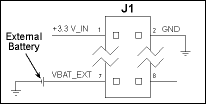
A lithium battery with a nominal voltage of 3 V and a minimum capacity of 165 mA·h is recommended. A lithium battery is strongly recommended because of its nearly constant nominal voltage over most of its life.
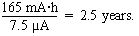
The drain on the battery by the RCM4510W is typically 7.5 µA when no other power is supplied. If a 165 mA·h battery is used, the battery can last about 2.5 years:
The actual battery life in your application will depend on the current drawn by components not on the RCM4510W and on the storage capacity of the battery. The RCM4510W does not drain the battery while it is powered up normally.
Cycle the main power off/on after you install a backup battery for the first time, and whenever you replace the battery. This step will minimize the current drawn by the real-time clock oscillator circuit from the backup battery should the RCM4510W experience a loss of main power.
NOTE Remember to cycle the main power off/on any time the RCM4510W is removed from the Prototyping Board or motherboard since that is where the backup battery would be located. Rabbit's Technical Note TN235, External 32.768 kHz Oscillator Circuits, provides additional information about the current draw by the real-time clock oscillator circuit.
C.1.2 Battery-Backup Circuit
Figure C-2 shows the battery-backup circuit.
The battery-backup circuit serves three purposes:
- It reduces the battery voltage to the SRAM and to the real-time clock, thereby limiting the current consumed by the real-time clock and lengthening the battery life.
- It ensures that current can flow only out of the battery to prevent charging the battery.
- A voltage, VOSC, is supplied to U11, which keeps the 32.768 kHz oscillator working when the voltage begins to drop.
C.1.3 Reset Generator
The RCM4510W uses a reset generator to reset the Rabbit 4000 microprocessor when the voltage drops below the voltage necessary for reliable operation. The reset occurs between 2.85 V and 3.00 V, typically 2.93 V. Since the RCM4510W will operate at voltages as low as 3.0 V, exercise care when operating close to the 3.0 V minimum voltage (for example, keep the power supply as close as possible to the RCM4510W) since your RCM4510W could reset unintentionally.
The RCM4510W has a reset output, pin 3 on header J1.
C.1.4 XBee RF Module Power Supply
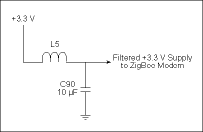
The XBee RF module is isolated from digital noise generated by other components by way of a low-pass filter composed of L5 and C90 on the RCM4510W as shown in Figure C-3. The filtered power supply powers the XBee RF module, and is available via pin 8 of auxiliary I/O header J4 on the RCM4510W module. If you draw on this filtered power supply, the maximum current draw is 25 mA.
C.2 Powerdown Mode
The XBee RF module can power down the remaining RCM4510W circuitry via the
zb_Rabbit_poweroff()or thexb_sleep()Dynamic C function calls. The real-time clock and the data SRAM will still be powered during the powerdown from the +3.3 V DC supplied to the RCM4510W module via header J1 as long as that voltage exceeds the voltage of the backup battery.
| Rabbit—A Digi International Brand www.rabbit.com |
| |
|
|